R&D Offsite 2025: Building What’s Next, Together
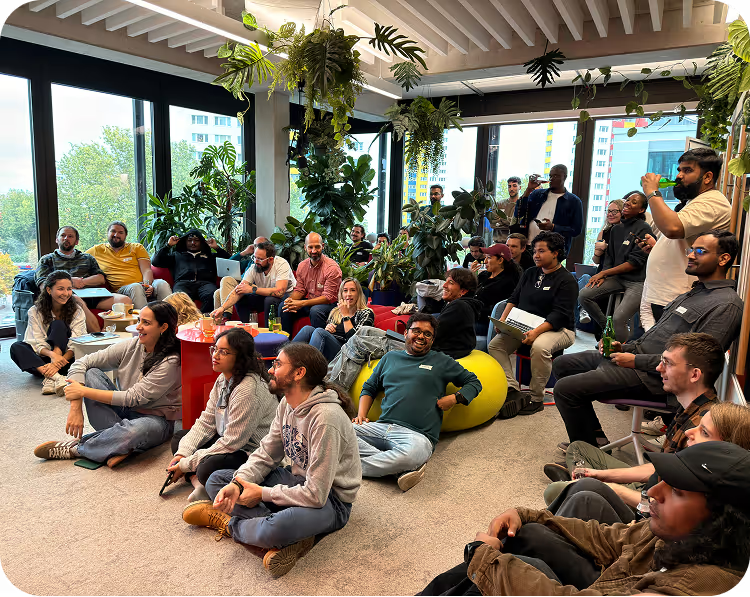
What happens when great minds meet with a shared purpose?
Earlier this year, our Product, Data, Learning Experience, and Tech teams came together in Berlin for our first-ever R&D Offsite; three energizing days of connection, collaboration, and creativity.
Together, we explored how to keep shaping the future of coaching; from strengthening our core product and scaling growth through AIMY™, to reimagining how we work across new cross-functional Tribes and a Platform Excellence Task Force.
We learned, experimented, and set our “Big Bets” for what’s next guided by a shared vision: one roadmap, one team.
Beyond the strategy sessions and hackathons, what stood out most was the spirit of collaboration, the energy that comes from people connecting in person to build something that matters.
Because when we invest in connection, we strengthen everything that follows: innovation, impact, and the future of coaching.
🎥 Watch the highlights from our R&D Offsite 2025 here.
FAQ
Success in leading through change is measured by how quickly performance recovers and how effectively new behaviors are embedded across the organization.
This includes both early signals such as clarity, confidence, and decision-making and longer-term outcomes like engagement, retention, and productivity. Organizations that track both behavioral and business indicators are better able to understand progress, identify risks, and sustain performance beyond the initial recovery phase.
Ultimately, successful restructuring is not defined by the new org chart, but by how quickly people adapt and how consistently they perform in the new environment.
When the change curve is not actively managed, organizations face compounding performance risks. These include slower decision-making, increased coordination costs, declining engagement, and prolonged productivity loss.
Over time, teams may revert to old behaviors, momentum fades, and change fatigue increases especially if multiple transformations occur in succession.
Each additional week spent in the dip increases the cost of disruption and delays the realization of transformation benefits, making recovery slower and less effective.
Organizations shorten the change curve by actively supporting behavior change at scale. This requires more than one-off interventions, it demands continuous reinforcement, alignment across leadership levels, and integration into daily work.
Behavioral science shows that change only sticks when it is reinforced consistently and over time. Organizations that provide structured, ongoing support such as coaching, are better able to accelerate adaptation, reduce uncertainty, and restore performance faster.
The goal is not to eliminate the dip, but to reduce its duration and severity.




.avif)